
Preparing steel edges for painting: deburring alone is not enough
The broad surfaces of a steel structure have been carefully prepared, yet coating damage first appears along its edges. In this situation, examine the edge geometry too. Removing burrs may be necessary, but does not by itself establish whether the edge is suitable for the specified coating system.
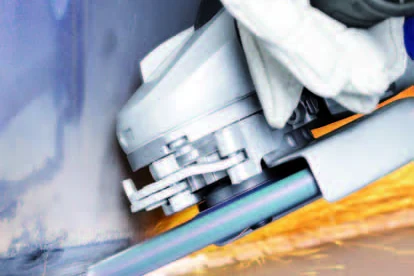
Why is edge preparation a separate task?
At a sharp edge, coating thickness can develop less favourably than on the adjacent flat surface. Producing an appropriate edge shape therefore forms part of preparation for corrosion protection. Surface cleanliness and the surface condition required by the coating remain essential too.
Do not derive the required edge shape from a general workshop rule. The design, applicable technical requirements and coating specification determine the necessary preparation. A chamfer or radius that worked on another job is not automatically acceptable for the new application.
Deburring, chamfering and rounding are different
Deburring removes protruding material left by machining. Chamfering and rounding, by contrast, deliberately change the edge geometry. Saying that an edge has been ground does not define which inspectable result has been achieved.
Select the tool according to access, the amount of material to be removed and the specified shape. External edges, hole rims and internal cut-outs can require different designs. Check compliance on the workpiece rather than assuming it from the tool's name.
Edge geometry and surface condition both matter
Machining the edge does not replace the necessary removal of rust, scale or other contamination that can impair adhesion. The reverse is also true: cleaning does not correct an unsuitable edge shape left on an otherwise clean surface.
After machining, examine edge transitions and neighbouring areas. Do not leave unchecked locations that were difficult for the tool to reach. Handover for coating must address the complete preparation requirement.
A short checklist before painting
- Have the required edge geometry and inspection method been clearly defined?
- Have hole rims and cut-out edges been inspected as well as external edges?
- Are the coating system's cleanliness and preparation requirements satisfied?
- Has machining debris been removed, and is the component protected from recontamination?
In repeat production, an approved sample can help align expectations, but it does not replace the necessary dimensional and surface checks.
The structural design and coating-preparation requirements are important inputs when discussing tooling with Ferroszerszám. They provide the basis for selecting a tool suited to producing the specified edge geometry.